An interesting read and a heads up to designers, ship operators/owners and Engineering crew onboard ship.
Canadian Marine Transportation Safety Investigation Report M18P0014 – Engine room fire in Container vessel January 2018

Executive summary
On 31 January 2018, a fire broke out in the engine room of the container vessel MOL Prestige while the vessel was at sea 146 nautical miles south-southwest of Haida Gwaii, British Columbia (BC). There were 22 crew and 1 supernumerary on board at the time. The fire was eventually extinguished. Five of the crew members were seriously injured. A Royal Canadian Air Force helicopter evacuated 2 of the crew members to hospital in the Village of Queen Charlotte, BC. The Canadian Coast Guard ship Sir Wilfrid Laurier assisted until a salvage tug arrived and towed the disabled vessel to Seattle, Washington, United States.
The investigation identified a number of safety deficiencies described below.
Engine room maintenance and practices
The investigation identified maintenance-related issues in the engine room of the MOL Prestige. The level indicators on the settling and service tanks were inoperative and the engineers had to climb onto the tanks and unbolt a blind flange in order to sound the tank. Over time, the blind flange was left off the level indicator pipe for the settling tank. As well, at some point, the high-temperature alarm on the settling tank had been set at 30 °C above the safe maximum temperature. This meant that any water entering the settling tank might be subject to frothover because oil in the tank above 100 °C would cause any water in the tank, or added to the tank, to boil instantly. The high temperature in the settling tank, in conjunction with the open level indicator pipe on the settling tank, created unsafe conditions that allowed frothover to expunge oil and fumes out of the tank and the steam explosion, which resulted in the fire.
The responsibility for ensuring that equipment in the engine room is maintained safely and that engine room practices are safe is shared by vessel management and crew. In the case of the MOL Prestige, the year before the occurrence, the technical management of the vessel had changed and a new reporting system had been introduced. During this period of change, issues that had been identified by the engine room crew went unaddressed and, as a result, because the engine room equipment was not maintained as required by company procedures and the manufacturer’s specification, some of the engine room equipment presented hazards.
If those responsible for ensuring an engine room is maintained sufficiently do not work together to mitigate hazards (leaks, broken equipment, adaptations) in a timely and efficient manner, there is a risk that engine room equipment will fail, leading to accidents.
Egress and evacuation from engine room
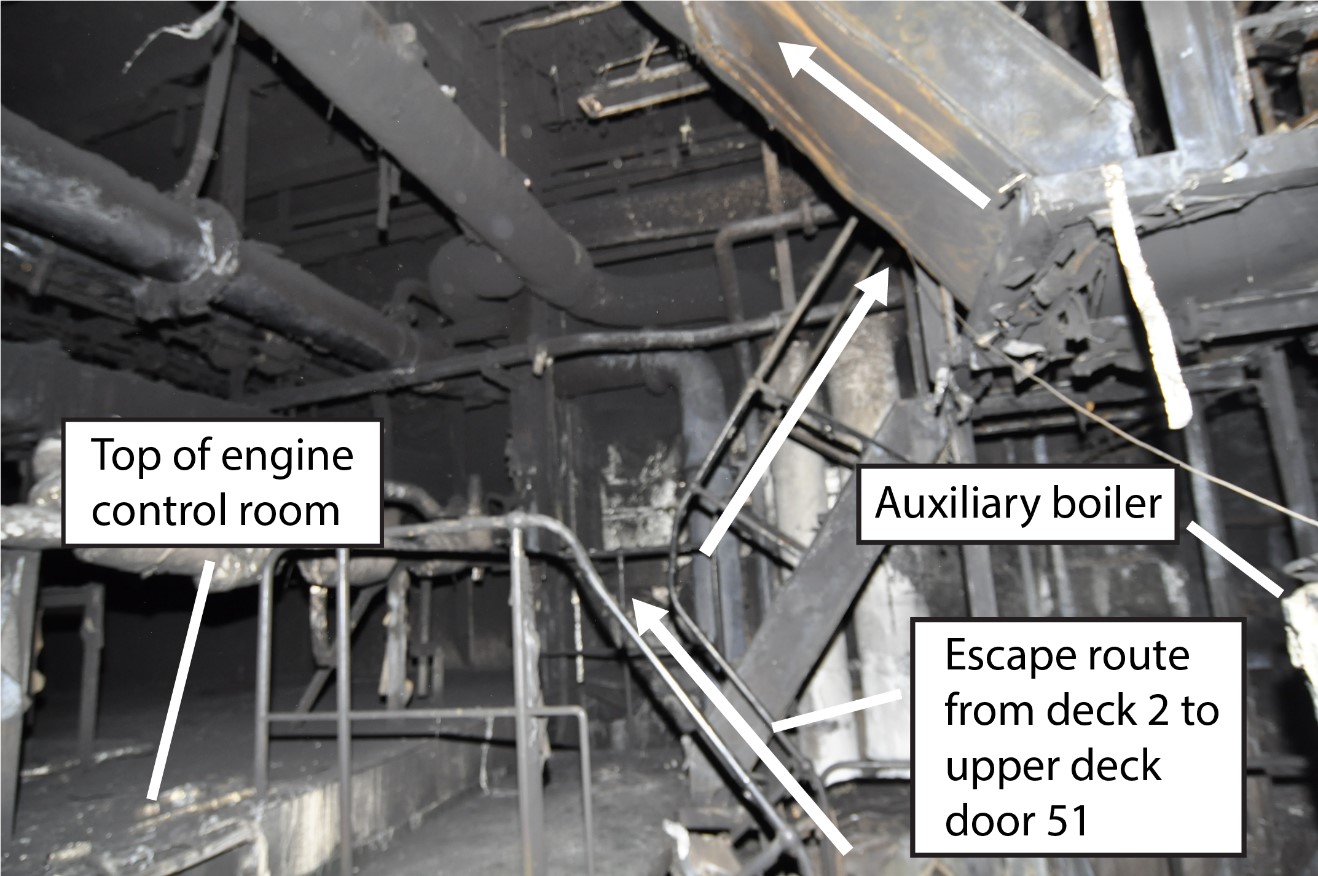
Timely egress and evacuation from an engine room is essential in the event of an engine room fire. In this occurrence, the engine room personnel met in the engine control room as the fire began developing, but then became trapped once the fire escalated. A number of factors combined to make egress from the engine control room and subsequent evacuation efforts challenging, placing crew members at risk during the emergency response and prolonging the time that elapsed before egress was possible. During this delay the fire continued to burn unabated.
Cargo vessels constructed after 01 January 2016 must meet regulations set out by The International Convention of Safety of Life at Sea (SOLAS) with respect to escape arrangements from engine control rooms. Although not required for cargo vessels such as the MOL Prestige, which was constructed prior to 01 January 2016, an evacuation analysis of the engine room may have prompted an evaluation of the necessary means of escape from the engine control room, including the placement of the emergency escape breathing devices, the markings required, and the visibility of the exit doors.
If the owners/operators of cargo vessels constructed before 01 January 2016 do not evaluate evacuation routes to ensure that escape arrangements from engine control rooms provide an equivalent level of safety to that required by the current SOLAS regulations, there is a risk that the means of escape provided will be insufficient to support safe and timely egress to a safe position outside machinery spaces.
Emergency preparedness and drills
To respond effectively to a fire, crew must be trained in emergency procedures and must practise using emergency equipment. Drills that are realistic and include varying scenarios help to increase a crew’s preparedness and effectiveness in responding to a fire. The crew on the MOL Prestige had regularly practised drills related to fire in the engine room and rescue from enclosed space, but not all crew members had had the opportunity to practise donning firefighting equipment, and the drills involving fire had not been conducted with realistic scenarios involving unexpected events. The investigation found that the crew had not had the opportunity to practice all of their designated duties and related procedures during drills.
If emergency drills are not routinely practised and evaluated with all of the crew members’ designated duties, or do not include realistic scenarios, there is a risk that the crew will be unprepared in an emergency.
Maintenance of fixed fire suppression systems
The MOL Prestige was fitted with a fixed fire suppression system, but it had leaks in safety-critical units and hoses that went undetected until the system was inspected after the fire. The regulations specify that the system must be able to withstand a minimum bursting pressure and be subjected to an initial pressure test at the time of construction. There is also a requirement to hydraulically test all CO2 cylinders at regular intervals. However, this principle is not extended to include the distribution system, and there is no requirement for a pressure test to be carried out periodically during the life of the vessel. Inspection and testing regimes for CO2 systems must, therefore, contain provisions that will help ensure their continued integrity.
If critical on-board firefighting appliances, such as a fixed fire suppression system, are not maintained according to the manufacturer’s specifications and regulatory requirements, there is a risk that such systems will not function as intended in an emergency.
Safety management
The MOL Prestige had an audited safety management system that included procedures for hazard identification, for checks to engine room equipment, and for record keeping, among other things, but some of the safety issues identified during the investigation were not identified during audits or routine checks. Furthermore, none of the methods for hazard identification provided for by the vessel’s SMS were successful in leading to the timely correction of these issues.
If companies do not establish an effective SMS that encourages crew to identify hazards and that supports the crew in developing safe and timely mitigations, there is a risk that hazardous operating conditions will remain.
Read the online report here: https://www.tsb.gc.ca/eng/rapports-reports/marine/2018/m18p0014/m18p0014.html
Download and read the full report here: https://bit.ly/3iOWXYk
Private sector participation at Port of Cape Town critical for growth and jobs
“However, for the Port of Cape Town to truly reach its full potential, and perform at international best practice levels, the private sector’s participation must be brought on board formally. To boost economic growth that will enable the creation of many more jobs across the Western Cape, and this incredible and resilient country, this must be done sooner rather than later” concluded Minister Wenger.
The IMO GreenVoyage2050 Project is supporting shipping’s transition towards a low carbon future.
IMO-GreenVoyage2050 was established in May 2019 to support developing countries in meeting their commitment towards relevant climate change and energy efficiency goals for international shipping. GreenVoyage2050 was recently extended to run until 2030 and will support developing countries in achieving the Levels of Ambition set out in the 2023 IMO GHG Strategy.
Cape Town calls for deadline on private sector port involvement
12th January 2024 By: Irma Venter Creamer Media Senior Deputy Editor The City of Cape Town says it wants a “clear deadline” from Transnet and national government on private sector involvement in the Port of Cape Town. With a private sector partner set to start...
SAIMENA Donations to Lawhill Maritime Centre 2023
SAIMENA handed over two prizes to students at the LMC at their prize giving event on Friday 24 November 2023. I was accompanied by Jacques de Klerk, and Samantha Montes was also there (for CPUT), as well as SAIMENA member Johan Swart who is the board of LMC. Always...
NATIONAL PORTS AMENDMENT BILL | 2023 – draft
NATIONAL PORTS AMENDMENT BILL | 2023 - draft The National Ports Act 2005 (Act No. 12 of 2005) is almost 20 years since it was enacted into law in 2005. The Department of Transport is releasing this initial draft of the National Ports Amendment Bill, 2023 for purposes...
Loss of AHTS VOORTREKKER 30 years ago off Mossel Bay
This month 30 years ago saw one of the biggest tragedies in South African maritime history occur. The South African built, flagged and crewed AHTS VOORTREKKER capsized in adverse weather off Mossel Bay South Africa. The vessel floated upside down, for a few days...
New report says localisation policy locking South Africa into ‘wrong path’
This report below also finds applicability in the Maritime Sector, many of the DTIC policies put in place and especially the ITAC restrictions on buying second hand ships, are severely hampering the growth of ship building and repair in South Africa, the effect of...
SAIMENA Cape Branch had a great tribute lecture to SA AMANDLA ex John Ross Tug
The SAIMENA Cape Branch had a great tribute lecture to SA AMANDLA ex John Ross Tug. Delivered by Masters and Chief Engineers of the tug from Amsol. Thanks to Acelleron Turbo Systems for sponsoring the evening. We were pleased to welcome Rennie Govender, President of...
What Is Marine Engineering? (Is A Marine Engineering Degree Worth It?)
This is an american perspective but very worth watch if you want to get into Marine Engineering.https://youtu.be/cDxr0_7xCnc
Floating dock collapses on bulk carrier in Turkey
After the recent incident at the Cape Town Synchrolift, seems that this happens in more places. Highlighting the need for effective maintenance of docking facilities. KJW 14 Jun 2023. According to International news, an accident occurred at the Çındemir Shipyard, a...

https://youtu.be/kMlOwfNyzC0?list=UUoQbQE-aEhVBywNRB-XsHOQ