An interesting read and a heads up to designers, ship operators/owners and Engineering crew onboard ship.
Canadian Marine Transportation Safety Investigation Report M18P0014 – Engine room fire in Container vessel January 2018

Executive summary
On 31 January 2018, a fire broke out in the engine room of the container vessel MOL Prestige while the vessel was at sea 146 nautical miles south-southwest of Haida Gwaii, British Columbia (BC). There were 22 crew and 1 supernumerary on board at the time. The fire was eventually extinguished. Five of the crew members were seriously injured. A Royal Canadian Air Force helicopter evacuated 2 of the crew members to hospital in the Village of Queen Charlotte, BC. The Canadian Coast Guard ship Sir Wilfrid Laurier assisted until a salvage tug arrived and towed the disabled vessel to Seattle, Washington, United States.
The investigation identified a number of safety deficiencies described below.
Engine room maintenance and practices
The investigation identified maintenance-related issues in the engine room of the MOL Prestige. The level indicators on the settling and service tanks were inoperative and the engineers had to climb onto the tanks and unbolt a blind flange in order to sound the tank. Over time, the blind flange was left off the level indicator pipe for the settling tank. As well, at some point, the high-temperature alarm on the settling tank had been set at 30 °C above the safe maximum temperature. This meant that any water entering the settling tank might be subject to frothover because oil in the tank above 100 °C would cause any water in the tank, or added to the tank, to boil instantly. The high temperature in the settling tank, in conjunction with the open level indicator pipe on the settling tank, created unsafe conditions that allowed frothover to expunge oil and fumes out of the tank and the steam explosion, which resulted in the fire.
The responsibility for ensuring that equipment in the engine room is maintained safely and that engine room practices are safe is shared by vessel management and crew. In the case of the MOL Prestige, the year before the occurrence, the technical management of the vessel had changed and a new reporting system had been introduced. During this period of change, issues that had been identified by the engine room crew went unaddressed and, as a result, because the engine room equipment was not maintained as required by company procedures and the manufacturer’s specification, some of the engine room equipment presented hazards.
If those responsible for ensuring an engine room is maintained sufficiently do not work together to mitigate hazards (leaks, broken equipment, adaptations) in a timely and efficient manner, there is a risk that engine room equipment will fail, leading to accidents.
Egress and evacuation from engine room
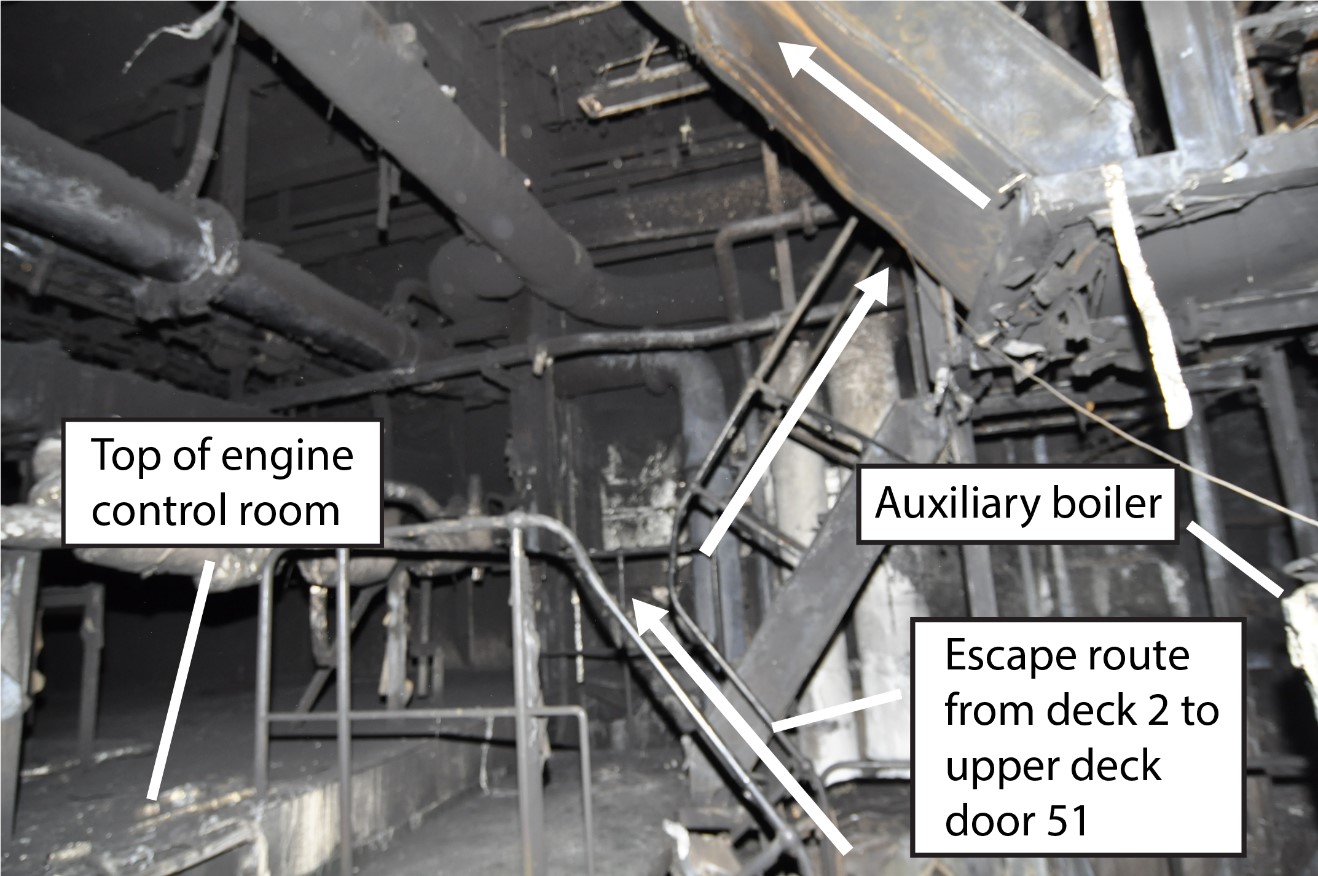
Timely egress and evacuation from an engine room is essential in the event of an engine room fire. In this occurrence, the engine room personnel met in the engine control room as the fire began developing, but then became trapped once the fire escalated. A number of factors combined to make egress from the engine control room and subsequent evacuation efforts challenging, placing crew members at risk during the emergency response and prolonging the time that elapsed before egress was possible. During this delay the fire continued to burn unabated.
Cargo vessels constructed after 01 January 2016 must meet regulations set out by The International Convention of Safety of Life at Sea (SOLAS) with respect to escape arrangements from engine control rooms. Although not required for cargo vessels such as the MOL Prestige, which was constructed prior to 01 January 2016, an evacuation analysis of the engine room may have prompted an evaluation of the necessary means of escape from the engine control room, including the placement of the emergency escape breathing devices, the markings required, and the visibility of the exit doors.
If the owners/operators of cargo vessels constructed before 01 January 2016 do not evaluate evacuation routes to ensure that escape arrangements from engine control rooms provide an equivalent level of safety to that required by the current SOLAS regulations, there is a risk that the means of escape provided will be insufficient to support safe and timely egress to a safe position outside machinery spaces.
Emergency preparedness and drills
To respond effectively to a fire, crew must be trained in emergency procedures and must practise using emergency equipment. Drills that are realistic and include varying scenarios help to increase a crew’s preparedness and effectiveness in responding to a fire. The crew on the MOL Prestige had regularly practised drills related to fire in the engine room and rescue from enclosed space, but not all crew members had had the opportunity to practise donning firefighting equipment, and the drills involving fire had not been conducted with realistic scenarios involving unexpected events. The investigation found that the crew had not had the opportunity to practice all of their designated duties and related procedures during drills.
If emergency drills are not routinely practised and evaluated with all of the crew members’ designated duties, or do not include realistic scenarios, there is a risk that the crew will be unprepared in an emergency.
Maintenance of fixed fire suppression systems
The MOL Prestige was fitted with a fixed fire suppression system, but it had leaks in safety-critical units and hoses that went undetected until the system was inspected after the fire. The regulations specify that the system must be able to withstand a minimum bursting pressure and be subjected to an initial pressure test at the time of construction. There is also a requirement to hydraulically test all CO2 cylinders at regular intervals. However, this principle is not extended to include the distribution system, and there is no requirement for a pressure test to be carried out periodically during the life of the vessel. Inspection and testing regimes for CO2 systems must, therefore, contain provisions that will help ensure their continued integrity.
If critical on-board firefighting appliances, such as a fixed fire suppression system, are not maintained according to the manufacturer’s specifications and regulatory requirements, there is a risk that such systems will not function as intended in an emergency.
Safety management
The MOL Prestige had an audited safety management system that included procedures for hazard identification, for checks to engine room equipment, and for record keeping, among other things, but some of the safety issues identified during the investigation were not identified during audits or routine checks. Furthermore, none of the methods for hazard identification provided for by the vessel’s SMS were successful in leading to the timely correction of these issues.
If companies do not establish an effective SMS that encourages crew to identify hazards and that supports the crew in developing safe and timely mitigations, there is a risk that hazardous operating conditions will remain.
Read the online report here: https://www.tsb.gc.ca/eng/rapports-reports/marine/2018/m18p0014/m18p0014.html
Download and read the full report here: https://bit.ly/3iOWXYk
SAIMENA AGM 2022
The South African Institute of Marine Engineers and Naval Architects (SAIMENA) held their 2022 AGM on 6 April 2022.This was conducted in an online meeting format, which we have now become accustomed too, and also has the great advantage that SAIMENA members from Cape...
Lessons learned: Increase the safety awareness of working on hot fluid systems
Hong Kong Merchant Shipping informs about a fatal accident that happened on board during the repair of an outlet valve of the exhaust gas boiler. The incident A fatal accident happened on board a Hong Kong registered container carrier when the vessel was berthed...
Dry docking: A challenging project
Drydock sessions is considered a project; thus project management principles can be effectively applied by Capt. Yiannis Kapageridis , January 25, 2022, in Maritime Knowledge, Opinions QA Department of TMS Tankers Ltd as Safety Superintendent/Auditor. A project is...
Kenya ratifies the 2012 Cape Town Agreement (STCW-F)
On 17 March 2022, Kenya ratified the 2012 Cape Town Agreement and the International Convention on Standards of Training, Certification and Watchkeeping for Fishing Vessel Personnel (STCW-F). The 2012 Cape Town Agreement (CTA) brings in mandatory safety requirements...
Western Cape fishing harbours revamp almost complete
According to the government’s Public Works and Infrastructure Minister, Patricia de Lille, the programme aimed at refurbishing Western Cape fishing harbours is expected to be completed as early as next month. de Lille said this at a media briefing on the...
Latest Two Oceans Journal released
SAIMENA is pleased to publish the latest edition of the Two Oceans Journal for our members and friends. Enjoy the read.
SAIMENA renews Co-Operation Agreement with the Royal Institution of Naval Architects (RINA)
The South African Institute of Marine Engineers and Naval Architects (SAIMENA) is pleased to announce the renewal of our Agreement of Co-Operation withthe Royal Institution of Naval Architects (RINA). This Agreement, first established in 1998, is renewed for a further...
IMO’s Sub-Committee on Ship Design and Construction (SDC 8) meets
The IMO Sub-Committee on Ship Design and Construction (SDC 8) met in virtual session from 17 to 21 January 2020. Through the good offices of the IMO Media service and Africa PORTS & SHIPS maritime news we are able to publish highlights of the session. Reducing...
Endurance 2022:- The hunt for Shackleton’s lost ship in Antarctica
SA AGULHAS 2” sails from Cape Town on Saturday 5th February with a 65 member team of FHMT (the Falkland’s Maritime Heritage Trust who are the Charterers) onboard to try and find the wreck of Sir Ernest Shackleton’s “ENDURANCE” in the Weddell Sea. Above: ENDURANCE...
Cape Town congestion puts South Africa’s fruit at risk
CONGESTION at Cape Town harbour has resulted in ships waiting for up to 14 days for a berth, thus threatening South Africa's vital fruit exports, reports the Cape Town Argus.The provincial government's hopes of economic recovery, which had been pinned on the export...

https://youtu.be/kMlOwfNyzC0?list=UUoQbQE-aEhVBywNRB-XsHOQ